|
|
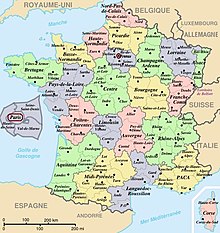
France is a country located primarily in Western Europe, but containing territory in South America, the Caribbean, and the Indian Ocean, as well as numerous territories of various status. In Europe France borders the Atlantic Ocean and the Mediterranean. To the west is the Bay of Biscay, to the north is the English Channel.
Area
Total area: 674,843 km2
(Whole territory of the French Republic, including all the overseas departments and territories, but excluding the disputed French territory of Terre Adélie in Antarctica)
Metropolitan France: 551,695 km2
(Metropolitan - i.e. European - France only, French National Geographic Institute data)
Metropolitan France: 543,965 km2
(Metropolitan - i.e. European - France only, French Land Register data, which exclude lakes, ponds, glaciers larger than 1 km2
, and estuaries)
Terrain
Mostly flat plains or gently rolling hills in north and west.
Elevation extremes:
Lowest point: Rhone River delta -2 m
Highest point: Mont Blanc 4,808 m
Land use
Arable land: 33%
Permanent crops: 2%
Permanent pastures: 20%
Forests and woodland: 27%
Other: 18% (1993 est.)
Natural resources
Coal, iron ore, fish, zinc
Natural hazards
Flooding; avalanches; forest fires; Earthquakes
Environment
Some forest damage from acid rain (major forest damage occurred as a result of severe December 1999 windstorm); air pollution from industrial and vehicle emissions; water pollution from urban wastes, agricultural runoff, high pesticide use (honeybee mortality )
Cities and towns
Cities and major towns, or those of historical significance, include:
Abbeville, Ajaccio, Albertville, Albi, Amiens, Angers, Angoulême, Aurillac, Avignon, Barbizon, Bastia, Besançon, Bordeaux, Belfort, Brest, Brive, Caen, Cahors, Calais, Cannes, Carcassonne, Chamonix, Charleville-Mézières, Châtellerault, Cherbourg, Chinon, Clermont-Ferrand, Colmar, Compiègne, Deauville, Dieppe, Digne-les-Bains, Dijon, Dole, Domrémy, Dreux, Dunkerque, Évreux, Grenoble, La Baule, La Rochelle, Le Havre, Laval, Lille, Limoges, Lyon, Marseille, Mende, Metz, Mont-de-Marsan, Montauban, Montpellier, Nancy, Nantes, Nice, Nîmes, Niort, Orléans, Paris, Pau, Périgueux, Perpignan, Poitiers, Quimper, Reims, Rennes, Rodez, Roubaix, Rouen, Saint-Gaudens, Saint-Étienne, Saint-Nazaire, Saint-Tropez, Saumur, Sète, Soissons, Strasbourg, Tarbes, Toulon, Toulouse, Tours, Tourcoing, Troyes, Valence, Versailles, Vichy
Flora and Fauna
An open grassland during the Pleistocene Ice Age, France gradually became forested as the glaciers retreated starting in 10,000 BC. Clearing of the primeval forests began in Neolithic times, but they were still fairly extensive until major clearing began in medieval times. By the 15th century, France had largely been denuded of its forests and was forced to rely on Scandinavia and their North American colonies for lumber. Significant remaining forested areas are in the Gascony region and north in the Alsace-Ardennes area. The Ardennes Forest was the scene of extensive fighting in both world wars.
In prehistoric times, France was home to large predatory animals such as wolves and brown bears, as well as herbivores like elk. The larger fauna have disappeared outside of the Pyrenees Mountains where bears live as a protected species. Smaller animals include martens, wild pigs, foxes, weasels, bats, rodents, rabbits, and assorted birds.
_______________________________________
How many people can do it like me?
Zero! Be so cool like me?
Zero!Else that can make it so hot like me
Zero!Girl you know there ain't nobody, nobody
|
|